UK Savings Account Statistics 2025

This page includes relevant UK Savings Account Statistics, with information on different ways to save money, help to buy statistics, help to save statistics, and child trust fund statistics.
UK savings account statistics show that seven in 10 (71%) adults use a savings product. Given how much time and effort people put into building up their savings, we’ve conducted a deep statistical dive into UK savings accounts in 2025.
We’ve looked into the different methods UK savers use to build up their rainy day fund, plus we investigate the popularity of Lifetime and Help to Save ISAs, as well as looking into pensions and the top retirement savings statistics for 2025.
Top 10 must-know UK savings account statistics for 2025
As of 2025, seven in 10 (71%) UK adults are subscribed to a savings product.
In 2023–24 56,900 individuals made a Lifetime ISA withdrawal in order to purchase a home, with an average withdrawal value of £14,927.
There are 62,050 Help to Save ISA accounts, as of 2023–24, with new deposits totalling almost £111.7 million.
Private pension membership declined by 9.14% between 2021–22 and 2022–23, to 6.76 million members.
Despite falling membership, individual private pension contributions reached a record high in 2022–23, at £12.83 billion.
The latest figures from 2022–23 indicate that the total market value of ISAs sits at £71.63 billion.
The average value of ISAs was £5,757 for the same period.
Middle incomes (£30,000-£49,999) record 151.35% more subscribers holding over £20,000 in their ISA, compared to those on the highest incomes (£150,000+).
Those aged 65+ are the most prevalent ISA subscribers, with over 6.3 million members.
Women are more likely to subscribe to an ISA account than men, but typically hold 8.69% less money in them compared to males.
Different ways of saving money
According to UK savings statistics for 2025, seven in 10 adults (71%) are subscribed to a savings product of some kind. The most popular type of product is a savings account (whether with a bank, building society, or NS&I), with nearly three-fifths (57%) of those surveyed by the Financial Conduct Authority (FCA) indicating that they use this type of product.
Most popular types of savings product
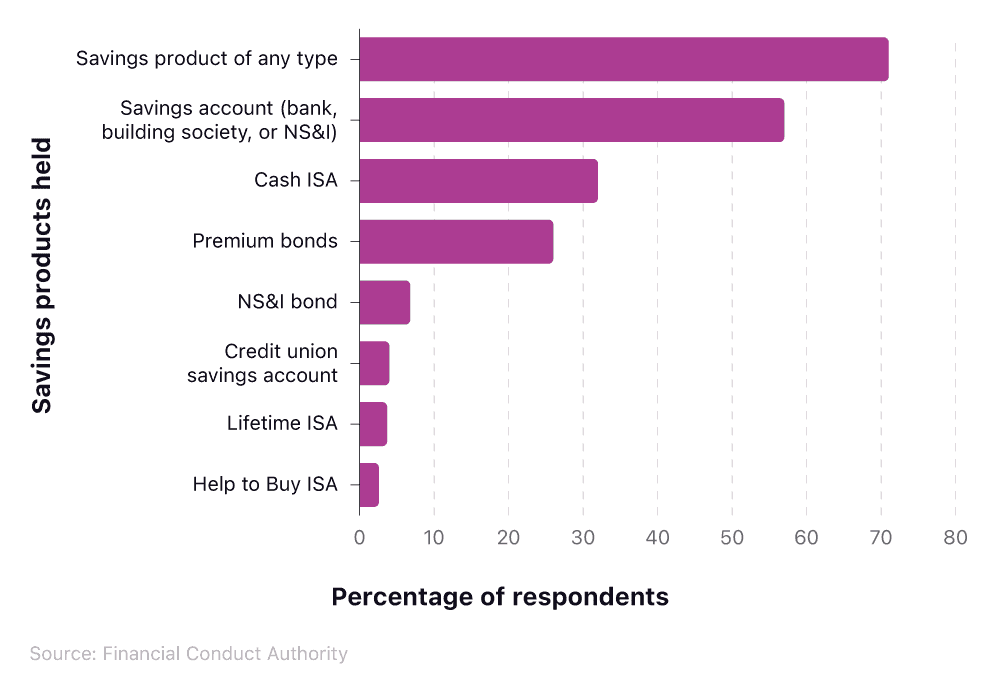
Bonds are also a popular savings option among UK adults, with a quarter (26%) opting for premium bonds, while 6.8% state they use NS&I bonds to save cash.
The choice between a bonds or savings account is a difficult one, with it very much being a matter of preference. A savings account offers the benefit of slow, guaranteed, incremental increases, whereas premium bonds can offer bigger rises but with more uncertainty.
Retirement savings statistics
Choosing the right savings account will very much depend on your circumstances, savings goals, and how accessible you need your money to be in the future. One of the main reasons for opening a savings account is to target a long-term savings goal: retirement.
As of August 2024, 13 million people were receiving their State Pension, an increase of 200,000 from the previous year. Of these, approximately 4.3 million were on the New State Pension (NSP), which was introduced in 2016. This was a rise of 710,000 compared to the previous year.
Alongside this, people may choose a Lifetime ISA to supplement their State Pension when they retire. This allows you to save up to £4,000 each tax year and receive a bonus of 25% from the Government. The amount you pay in is related to your annual ISA allowance, which stands at £20,000 as of 2025/26. This means that if you pay £4,000 a year into your Lifetime ISA, you can still pay £16,000 a year into other ISA accounts.
Comparing pension accounts will help find the product that is right for you and your circumstances. Whether that is an income drawdown pension, self-invested personal pension (SIPPS), or something more bespoke like a personal pension plan, the market is full of exciting opportunities with competitive rates.
Even if you already have one set up, transferring your pension to a new provider can help save on fees while simultaneously offering more control of your money.
Pension membership and average contribution
The latest pension membership statistics from HMRC reveal that 6.76 million adults were members of a personal private pension in 2022/23. This figure represents a decline of 9.14% in membership from the previous year (2021/22), when the total number of subscribers stood at 7.44 million.
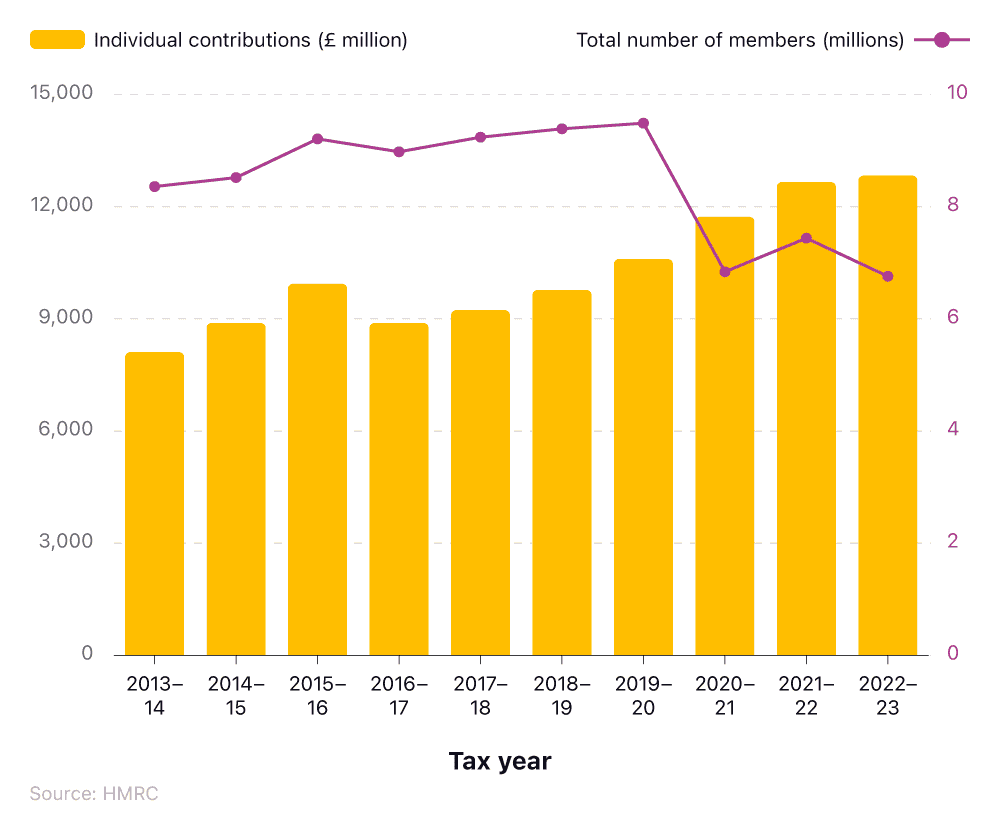
Despite private pension membership being at its lowest count over the last decade, UK adults recorded the highest individual contributions in 2022/23. At £12.83 billion, private pension scheme contributions have increased by 1.34% on the previous year (£12.66 billion), and 58.2% on 2013/14 (£8.11 billion).
ISA statistics
Choosing an ISA account allows you to earn interest without paying any income tax, provided you don’t pay in more than your tax allowance for the year. For the 2025/26 tax year, this stands at £20,000.
Number of ISA subscriptions by year
According to UK Government ISA statistics, 12.44 million adults were subscribed to an ISA in 2022–23. These numbers represent an increase of 5.86% on the previous year, bringing the number of subscriptions closer to pre-COVID levels (13.01 million in 2019–20).
ISA subscriptions in the UK
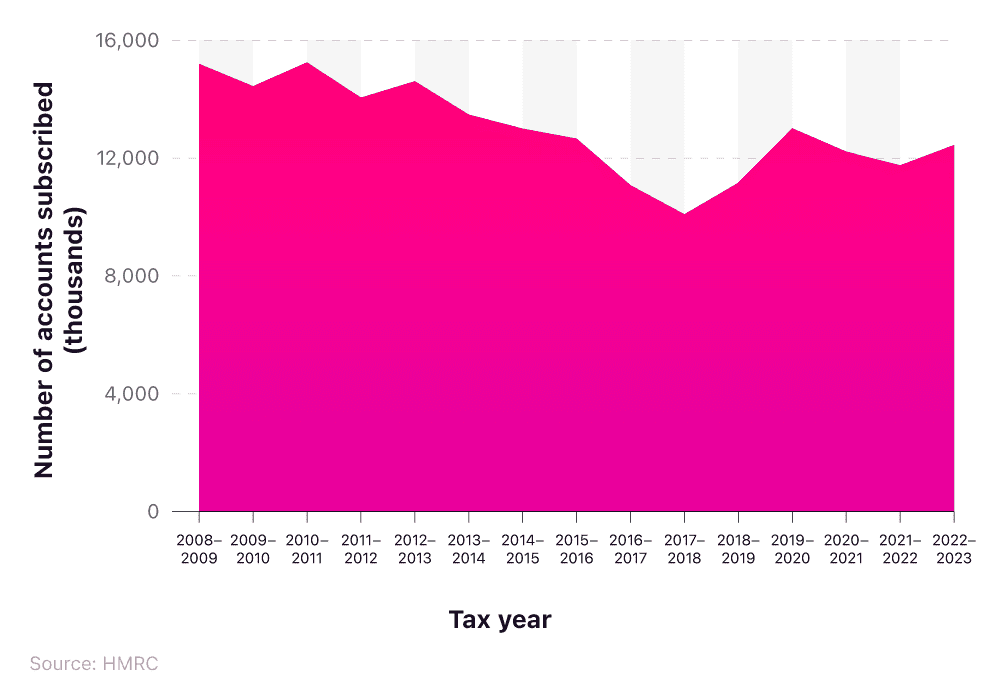
The figures show a slow but steady downward trend in the subscription of ISA accounts between 2012–13 (14.61 million) and 2018–19 (11.16 million), following a peak in 2010–11, when there were nearly 15.25 million subscriptions.
Market value of ISA accounts
Recent ISA statistics from our savings report show that, as of 2022–23, ISA accounts have a total market value of almost £71.63 billion. This figure represents a rise of 7% from the previous year.
Market value for ISA accounts in the UK
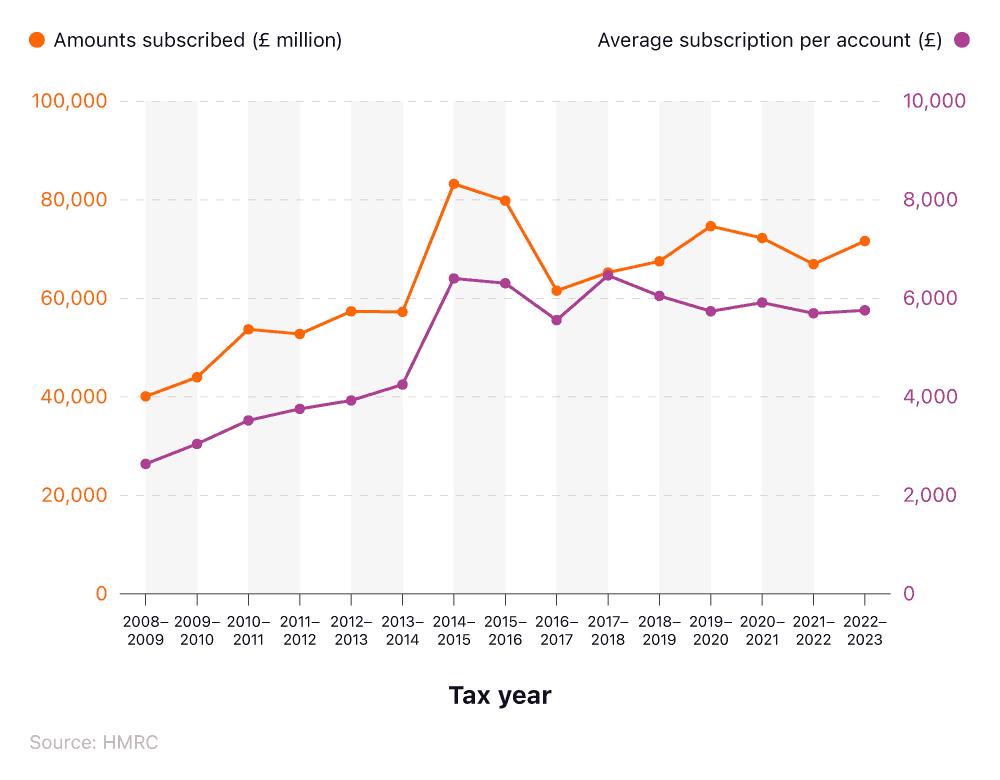
The total amount subscribed has fluctuated since the peak in 2014–15 (£83.2 billion), falling by more than a quarter (26.05%) to nearly £61.6 billion in 2016-17, before rising by more than a fifth (21.26%) to £74.6 billion in 2019-20.
The average subscription amount per account typically rises and falls in line with the total amount subscribed, but this is not always the case. Between 2010–11 and 2011–12, while the total amount of people who subscribed fell 1.76%, the average subscription value rose by 6.61% to £3,756.
A similar pattern was observed between 2012–13 and 2013–14, and 2019–20 and 2020–21. Conversely, between 2017–18 and 2018–19, and 2018–19 and 2019–20, the total amount of people who subscribed to an ISA rose, while the average subscription value fell.
If you want more information on the UK savings market as a whole then visit our UK saving market trends page for all the latest insight.
ISA value by income
According to the latest statistics from HMRC, the median ISA holder by income in 2021–22 had an annual income of between £20,000 and £29,999, with an average ISA market value of £31,014. This represents an increase of 5.5% from 2020 to 2021.
Those in the lowest income group (£0-£4,999) are most likely to report ISA savings of £1-£2,499, with 353,000 subscribers holding this amount. Meanwhile, the highest income group (£150,000+) are most likely to have ISAs with a value of £20,000+ (148,000 subscribers).
Interestingly, those in the middle income bands as set out by HMRC are the most likely to have an ISA value of £20,000+, with 372,000 subscribers earning £30,000-£49,999. That’s 151.35% more than those earning £150,000+.
ISA market in the UK by subscription value and income of subscriber
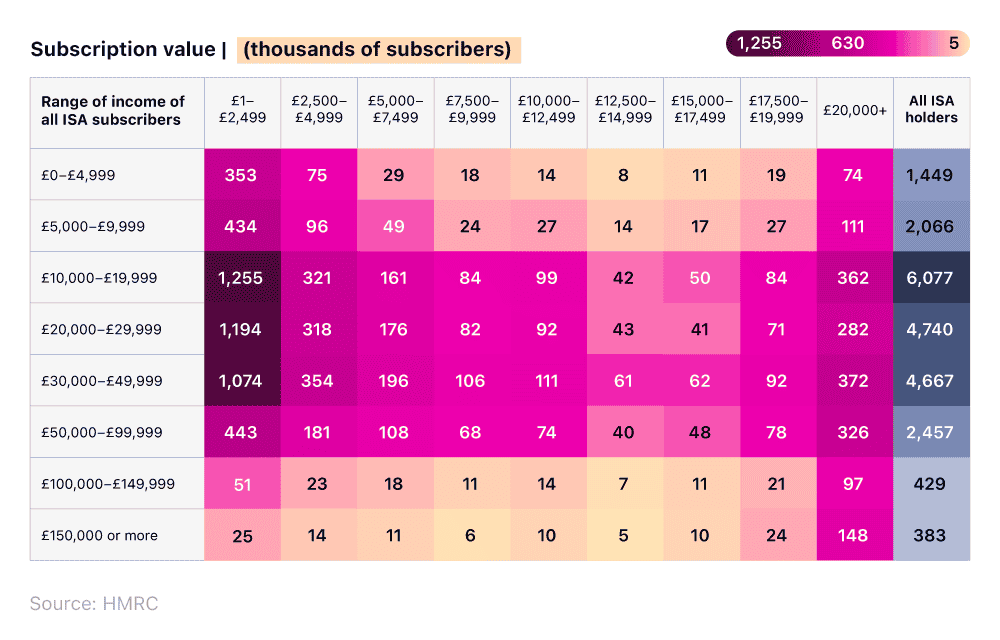
With over six million accounts, the income band of £10,000-£19,999 had the highest number of ISA holders in 2021–22. The quantity of ISA holders declined sharply by around half as earnings reached between £50,000 and £99,999, before declining further for those earning £150,000 or more, to around 383,000 account holders.
ISA holders by age
According to the latest ISA age statistics from HMRC, as the age groups increase, subscription figures remain fairly similar (between 3.4 and 3.9 million over the ages 25–54), before rising sharply, with the oldest age group (65+) up to 6.3 million.
ISA account holders in the UK by age, the number of accounts, and average market value
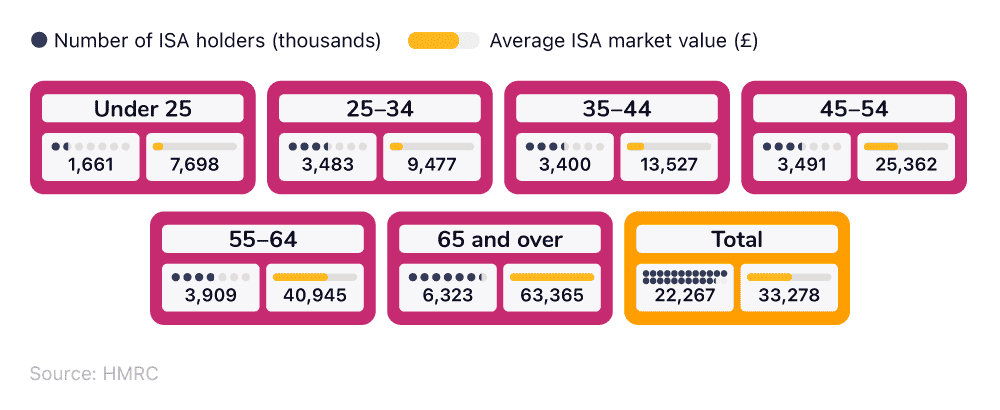
Despite having the highest number of ISA holders and the most savings (with an average market value of £63,365), almost seven in 10 (69%) account holders aged 65+ were found not to be active savers in 2020–2021.
Conversely, while ISA statistics show that under 25s have the least savings in their accounts (£7,698), 78% of account holders in this age group were found to be active savers during this same period.
Find out how you can earn interest tax-free with a cash ISA account for the over-60s
ISA holders by gender
The latest ISA holders by gender statistics indicate that women are more likely to hold an ISA account than their male counterparts, with 7.6% more women subscribed to an account than men.
ISA accounts in the UK by gender, based on the average market value and number of ISA account holders

However, ISA accounts held by men typically have a higher market value. While the average market value of women’s ISAs is £31,819, men hold 9.52% more in savings, with £34,849.
ISA holders in the UK by region
Our savings report shows that, with 3.39 million subscribers and an average ISA market value of nearly £40,400, residents of the South East are the most likely to have an ISA, and typically hold more savings than those in other regions.
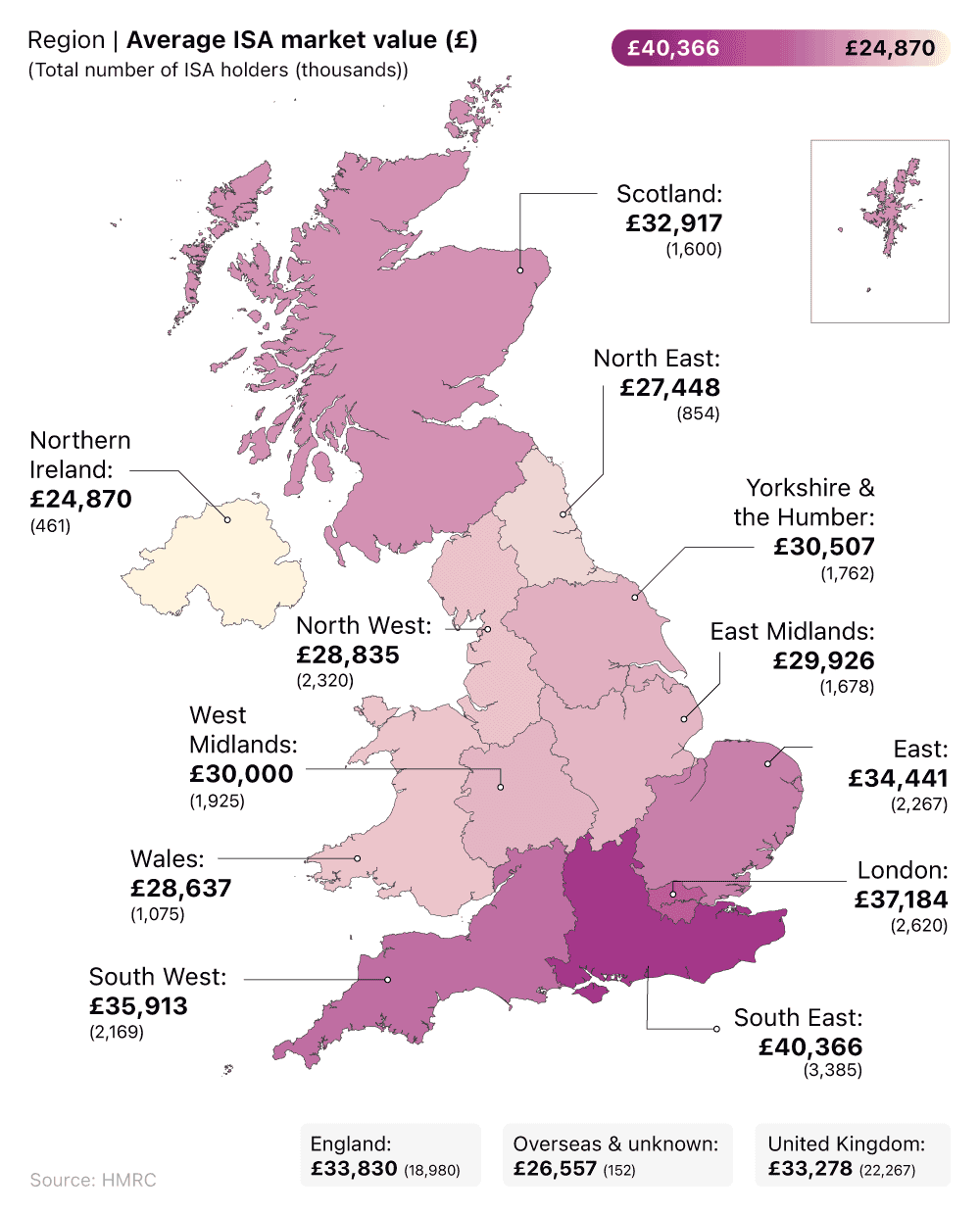
Northern Ireland reports both the lowest number of subscribers (461,000) and the lowest average market value of ISAs (£24,870). This indicates residents’ savings are 25.27% lower than the UK average and 38.39% lower than those in the South East.
Residents in England have, on average, slightly more (1.66%) in their ISAs than the UK average, at £33,830 and £33,278, respectively.
Lifetime ISA statistics
Number of individuals making Lifetime ISA withdrawals for a house purchase
Lifetime ISA (LISA) statistics for withdrawals for house purchases accelerated rapidly in the early years of the scheme.The low number of 50 LISA withdrawals for 2017–18 can be attributed to the fact that these accounts didn’t become available until April 2017. Therefore, not enough time had accumulated for most people to save enough cash, to withdraw for a house purchase.
The greatest rise was seen between 2019–20 and 2020–21, when 52.8% more subscribers made withdrawals from their Lifetime ISA in order to purchase a home (22,350 and 34,150, respectively).
Individuals making Lifetime ISA withdrawals to purchase a house
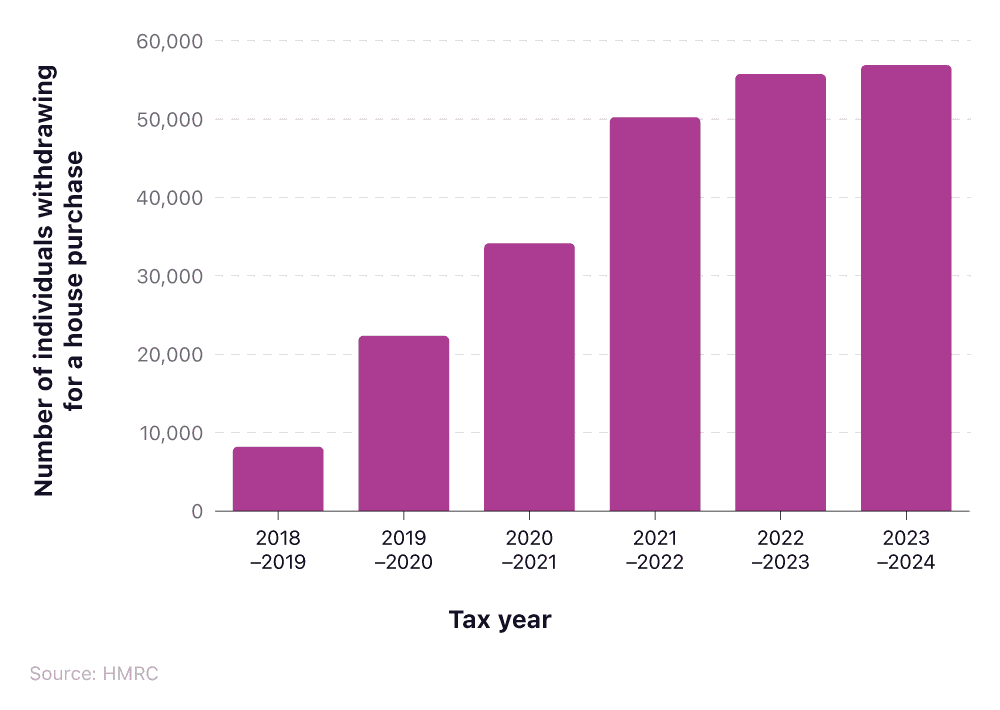
In the following year (2021−22), this growth slowed to 47.14% (50,250 subscribers), before dropping to 10.95% and 2.06% in subsequent years (55,750 in 2022–23, 56,900 in 2023−24).
Value of withdrawals for a house purchase
The total value of withdrawals has risen with each passing year since 2018−19. However, the percentage rise between years has dropped each year.
Average values of withdrawals by year
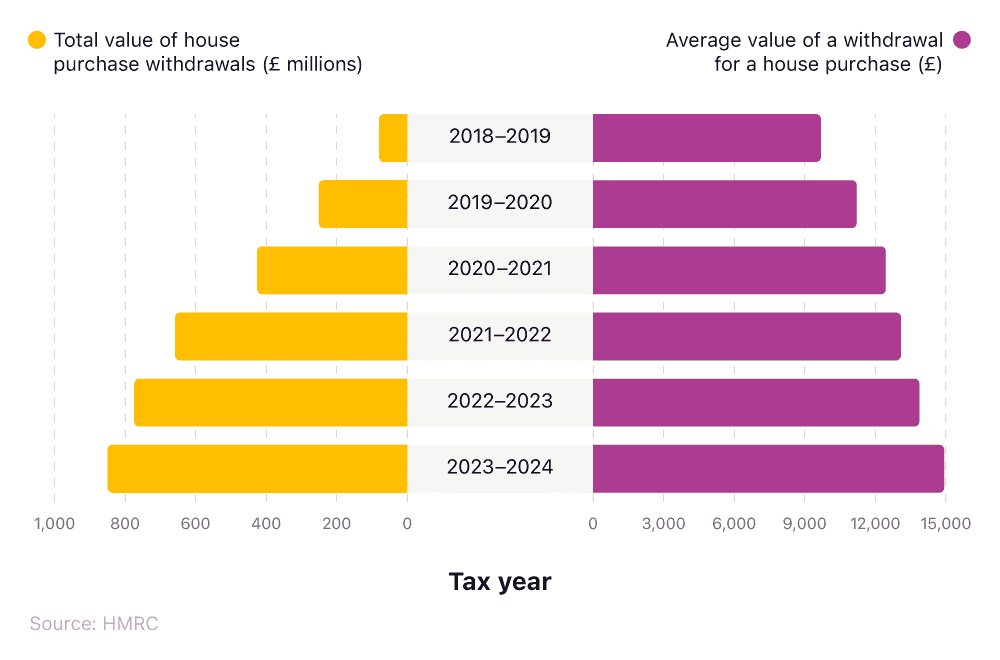
The biggest increase occurred between 2018−19 and 2019−20, when the total withdrawal increased by 251.1% (£170.96 million).
Similarly, the average value of withdrawals for a house purchase has also increased year-on-year. The greatest percentage rise in this value between years was also recorded between 2018−19 and 2019−20, at 15.7% (£9,687 to £11,207).
Following a fall in the percentage rise in average value over the subsequent years, the average amount withdrawn for a house purchase grew by 7.6% between 2022−23 and 2023−24, to a value of £14,927 (from £13,873).
Junior ISA saving account statistics
Choosing a junior ISA can help build up a pot of money (up to £9,000 in the 2025/26 tax year), ready for a child’s 18th birthday. As of 2025, the best junior cash ISAs will offer anything up to 4.15% AER.
The latest UK government data indicates there was a continued rise in junior ISA account subscriptions between the scheme’s introduction (2011) and 2019/20. While the nearly 1.25 million figure for 2022−23 indicates a record high, this represents a recovery following a dip in membership in 2020−21.
Junior ISA savings accounts in the UK
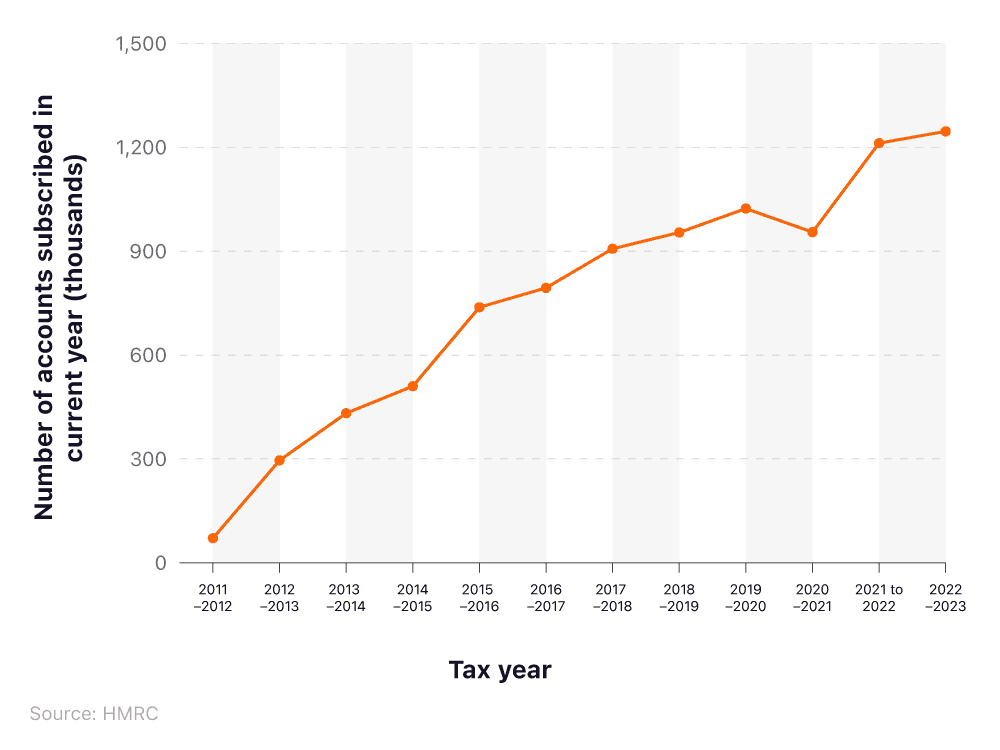
Aside from the initial leap in interest in the scheme’s first years (316.9% between 2011−12 and 2012−13), the biggest annual increase occurred between the years 2014-15 and 2015-16, when the number of Junior ISA subscriptions rose by over two-fifths (44.71%).
Market value of junior ISA accounts
The total market value of junior ISAs continues to grow exponentially every year, with the latest junior ISA saving account statistics revealing that £9.88 billion is held by these accounts across the country (2022−23).
Junior ISA accounts in the UK by total market value
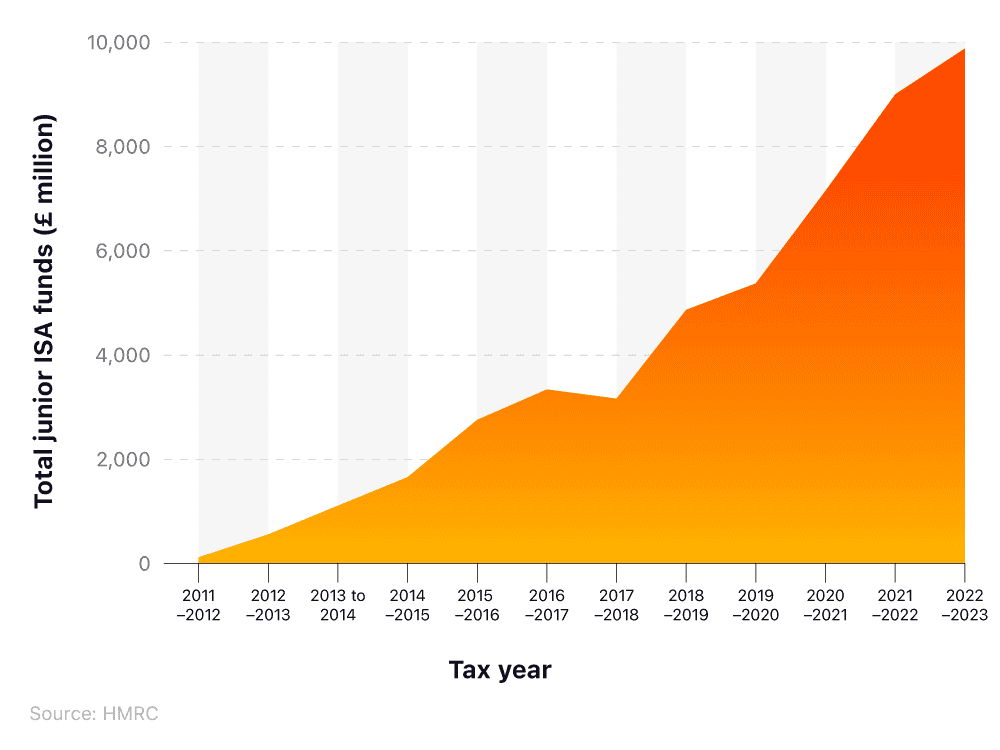
Since the scheme’s introduction, the total amount held by junior ISAs has increased year-on-year, except for 2017−18, when the £3.16 billion held in these accounts represented a 5.27% fall from the year prior (£3.34 billion).
With account uptakes remaining high and existing accounts increasing in value, it’s reasonable to expect these figures to continue to accelerate rapidly in the coming years.
Help to Save ISA statistics
Help to Save accounts are a government-run savings incentive for UK residents on lower incomes. For those who qualify, the UK Government will add 50p for every £1 saved over four years.
Opening a Help to Save account means you can save between £1 and £50 per month. By saving the maximum amount over four years, you’ll have saved £2,400 (48 months x £50). With the UK Government bonus of £1,200, this will mean a total saving of £3,600.
Help to Save ISA statistics by year
The annual figures for Help to Save ISA statistics show a significant rise of 57.65% in the number of accounts opened in 2020-21 vs 2019-20 before a similarly sharp (-30.42%) decline in new accounts the following year.
This decrease, from 108,150 to 75,250, is reflective of the changes in eligibility for the accounts during this time, which resulted in fewer people being able to qualify for a Help to Save account.
The number of individuals who have made a new deposit, and the total value of new deposits, continued to accelerate each year between 2019/20 and 2023/23, though the latest figures now indicate a decrease in both areas.
Accounts and value of new deposits of Help to Save ISAs
| Total number of accounts opened (1) | Number of individuals who have made a new deposit (1) | Total value of new deposits (£) (2) | Number of individuals who have made a withdrawal (1) | Total value of withdrawals (£) (2) | |
|---|---|---|---|---|---|
| 2019-20 | 68,600 | 954,250 | 45,261,000 | 43,150 | 6,108,000 |
| 2020-21 | 108,150 | 1,720,600 | 82,950,000 | 57,100 | 11,682,000 |
| 2021-22 | 75,250 | 2,263,350 | 109,549,000 | 93,700 | 23,351,000 |
| 2022-23 | 90,450 | 2,379,900 | 115,125,000 | 101,200 | 29,275,000 |
| 2023-24 | 62,050 | 2,303,750 | 111,695,000 | 95,450 | 27,676,000 |
(Source: HMRC)
In 2023/24, over 2.3 million individuals made a new deposit into their Help to Save ISA - a decrease of 3.2% on the year prior. In line with this, the total value of new deposits decreased by 2.98%, to a value of £111.7 million.
In 2023/24, the total value of withdrawals from Help to Save ISAs fell by 5.46% to £27,676,000. This is in line with the reduced number of individuals making a withdrawal, with the total making a withdrawal dropping by 5.68% over the same period.
Help to Save regional statistics
Our savings report indicates that, as of April 2024, there have been 516,800 Help to Save accounts opened across the UK, with the combined deposits valued at over £492.5 million.
The North West is responsible for both the most accounts opened and the highest value deposits, with opening figures of 67,650 and a total deposit value of nearly £63.5 million. This was followed by the South East, with the region obtaining the second-highest figures in both categories (60,500 and nearly £57.6 million, respectively).
Help to Save ISA account holders in the UK by region
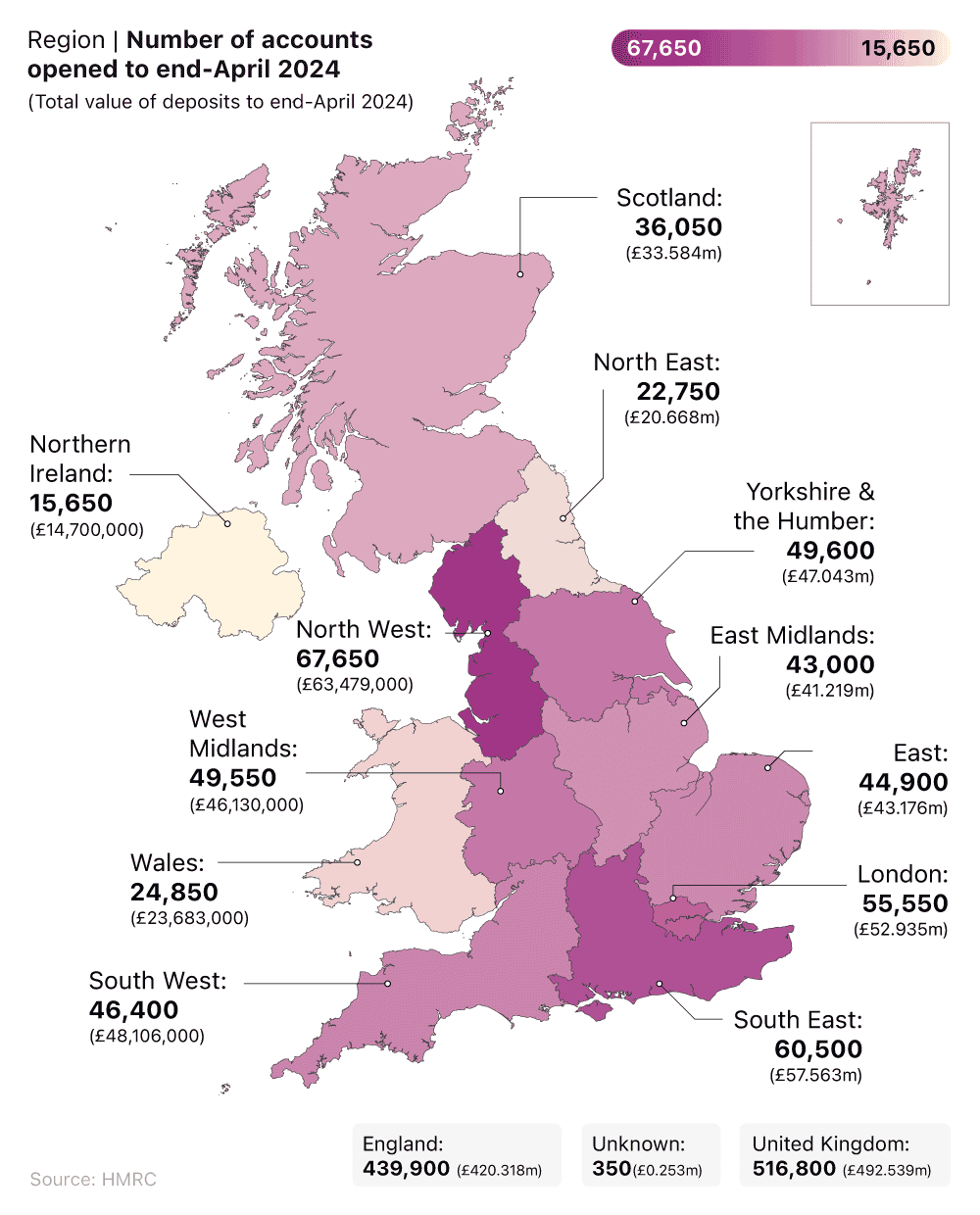
Help to Save figures for the North East show 22,750 accounts, which is particularly low compared to the rest of England. The next lowest region (the East Midlands) was found to have nearly double the number of account subscriptions at 43,000.
Outside of England, Northern Ireland’s account opening figures of 15,650 and a total deposit value of £14.7 million were by far the lowest in both categories across the UK. By comparison, the respective figures of 24,850 and £23.68 million for Wales and 36,050 and £33.58 million for Scotland provide context between the different countries of the UK.
FAQs
What is the ISA limit?
The ISA (Individual Savings Account) limit is the maximum amount of money you can contribute to your ISAs in a tax year. As of the 2025/2026 tax year, the ISA limit is £20,000. This means you can deposit up to £20,000 across all your ISAs, which could be spread across a Cash ISA, Stocks and Shares ISA, Innovative Finance ISA, or a Lifetime ISA, which has a limit of £4,000 within the £20,000 total.
How does an ISA work?
An ISA, or Individual Savings Account, works by providing a tax-free or tax-efficient wrapper around your savings or investments. Once your money is in an ISA, it can grow through interest or investment gains tax-free. You can choose between different types of ISAs including Cash ISAs, Stocks and Shares ISAs, Innovative Finance ISAs, and Lifetime ISAs. Each type has different rules and is suitable for different purposes.
How to get better at saving money?
Improving your saving habits can be achieved by setting clear financial goals, creating a realistic budget, and tracking your spending. It's also advisable to save a portion of your income regularly, cut unnecessary expenses, and consider using tools or apps that help manage your finances. Over time, these steps can help you become more disciplined with your finances and grow your savings.
Can you have a child trust fund and a junior ISA?
Yes, a child can have both a Child Trust Fund (CTF) and a Junior ISA, but you cannot contribute to both in the same tax year.
How are employer pension contributions calculated?
Employer pension contributions are typically calculated as a percentage of the employee's earnings. The percentage contributed can vary based on the employer's pension scheme and the terms of employment. Some employers may match the employee's contributions up to a certain percentage, while others may have a fixed contribution percentage regardless of the employee's contribution.
Methodology and sources
https://www.bsa.org.uk/media-centre/bsa-blog/september-2022/savings-accounts-it-pays-to-shop-around
https://commonslibrary.parliament.uk/research-briefings/cbp-7812/
https://www.gov.uk/government/statistics/annual-savings-statistics-2022
https://www.gov.uk/government/statistics/annual-savings-statistics-2023
https://maps.org.uk/en/media-centre/press-releases/2022/one-in-six-uk-adults-have-no-savings
https://www.bankofengland.co.uk/statistics/money-and-credit/2023/august-2023
https://www.bankofengland.co.uk/statistics/money-and-credit/2023/june-2023
About Lucinda O'Brien
Lucinda is a senior finance editor at money.co.uk and helps people to make confident financial decisions so they can make the most of their money.